
Running a Sex Offender Check in Harris County
The Texas Public Sex Offender Registry is the main public search channel for Harris County. Texas Department of Public Safety receives registration details from the local authority and publishes the fields that state law makes public. A Harris County sex offender check can begin with a name, a Texas SID number, an address, a city, a ZIP code, a county filter, or the map tool. Searching Harris County instead of Houston alone matters. The county includes Pasadena, Baytown, many other cities, and large unincorporated areas.
Start with the facts already known. A full name plus a middle name can reduce false matches. Address and map searches work better for neighborhood awareness, while a SID search points to one state identity record. Check the profile instead of relying on the first result row. Photos, aliases, physical details, offense facts, and current status can help distinguish people with similar names. A missing result does not promise that no registrant is nearby because registration compliance, update timing, and map precision can affect what appears.
The official registry search screen shows how Texas separates its search routes.
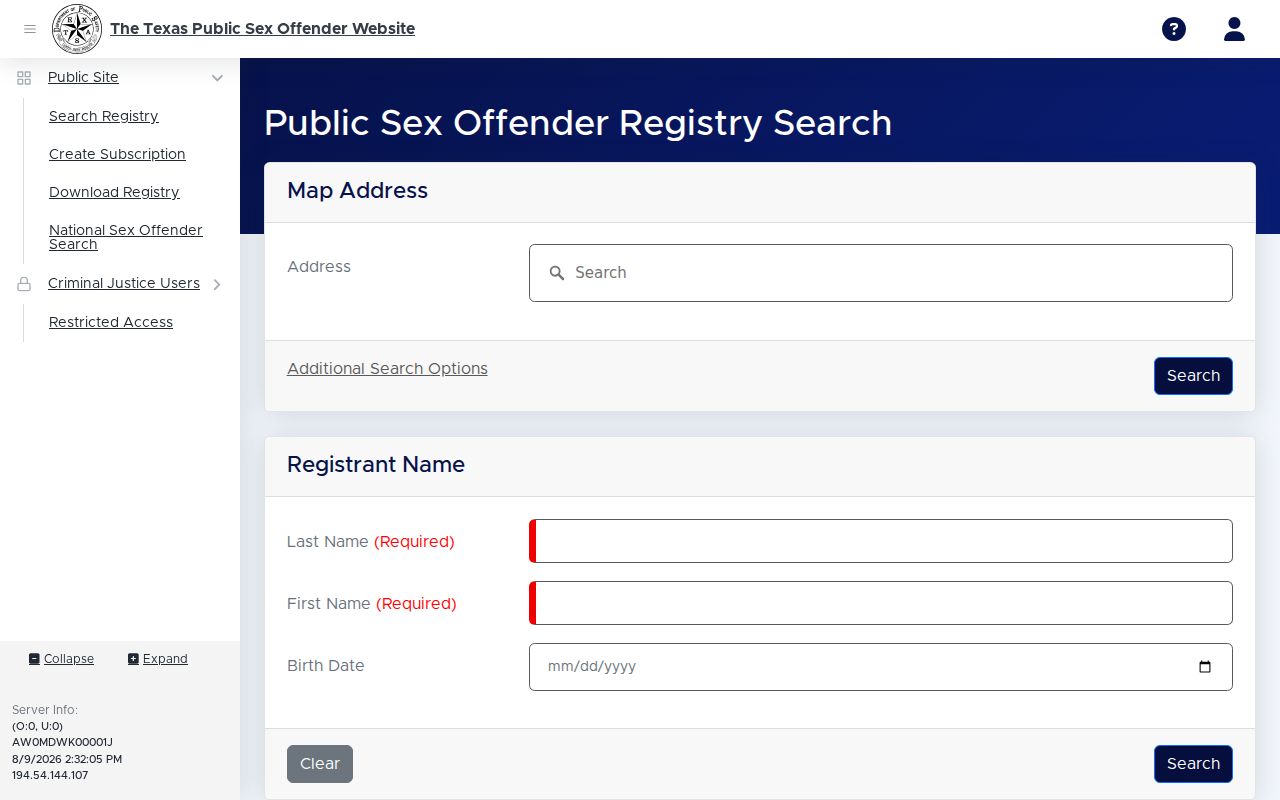
Those separate routes let a Harris County user choose a person-based search or a place-based view without copying private registry data elsewhere.
Harris County Registration Routes
Search and registration happen at different levels. DPS runs the public statewide database, but the person under a Chapter 62 duty reports to the local law-enforcement authority. Within a municipality, that is generally the municipal police department. A Houston resident ordinarily works with the designated function at the Houston Police Department. Someone who lives outside a municipality in Harris County generally reports through the Harris County Sheriff's Office.
The local office checks required information and sends registration data into the state system. This is why a public search question belongs with DPS, while a suspected failure to comply belongs with the correct local registering authority. Call before visiting. Registration is a compliance process with office-specific procedures, not a walk-in public-record counter. Chapter 62 calls for at least annual verification, and some categories must verify every 90 days. Changes to an address and other required facts also have short in-person reporting deadlines.
For a suspected reporting lapse, use the proper agency's nonemergency channel. Call 911 only when there is immediate danger. Do not approach the person shown in a registry result.
The authority that accepts registration also handles local verification. That makes location crucial in Harris County. A Houston address points to HPD, while an address in unincorporated Harris County points to HCSO. Another incorporated city may have its own police registration function. Confirm municipal boundaries and agency instructions first. Sending a concern to the correct unit gives staff the best chance to compare the public Harris County registry entry with the information that office is charged with maintaining.
Searching the Texas Public Sex Offender Registry
DPS presents Popular Searches, All Searches, and Map Search routes. The live portal controls may change, so read its current labels before submitting a Harris County sex offender search. The county option is useful for a broad sweep. City and ZIP fields narrow the place, while the map tool uses an address or pin and radius. Name searches can produce several records, especially with a common surname. The following order keeps the search focused and reduces the chance of confusing two people.
- Open the official Texas registry and read the displayed search terms and notices.
- Choose a name, SID, address, Harris County, or map route based on the facts known.
- Review all plausible results and compare names, aliases, photos, and physical traits.
- Open the profile and confirm the offense, location type, risk level, duration, and compliance status.
| Field Label | Type | Required | Notes |
|---|---|---|---|
| Last, First, Middle Name | Text | Route-dependent | Middle name is optional and can narrow a common-name match. |
| SID | Text | Route-dependent | Searches by the Texas state identification number. |
| Street Address, City, ZIP | Text | City is required on the city-address route | ZIP and street detail narrow a location query. |
| County | Dropdown | County-search route | Select Harris for a county-wide result set. |
| Address Type and Status | Dropdown and checkboxes | No | All is the documented default; Primary Only and Current Only may appear. |
| Map Location or Radius | Map and address control | Map-search route | Use the choices displayed on the live portal. |
Search and Clear are the basic buttons. Results may appear as records or on a map. Save enough context to repeat the search later, but avoid republishing a private person's profile or using a screenshot to target anyone.
Advanced and information searches may also show start and end date fields in MM/DD/YYYY format. Address Type, Primary Only, and Current Only controls should be read as scope choices, not identity proof. When a Harris County sex offender search produces several profiles, open each plausible record and compare the state identifier and stable physical facts. A county filter is broad; a street or ZIP query is narrow. Running both can reveal whether an overly tight first search left out a relevant registered location.
Harris County Map Search Limits
An address-radius search is a practical awareness tool, not a property-safety guarantee. The map reflects registered locations available to the public at the time DPS serves the result. It cannot prove that every required update has been filed, that every marker is exact, or that no person with an unlisted or nonpublic status is present. A pin may also represent a reportable location type rather than the conclusion a reader assumes from an ordinary home address.
Use the map to identify records worth opening. Then compare the profile's address type, current-status indicator, photo, aliases, and other matching facts. The Current Only and Primary Only controls can change the scope. A wider Harris County search may reveal records that a Houston-only search misses. If the concern crosses Texas lines, the National Sex Offender Public Website relays public data from participating jurisdictions. Return to the source state registry for the current profile because NSOPW does not replace Texas updates.
Note: A blank radius result is one search outcome, not an official assurance about a neighborhood or address.
Historical and nonprimary locations can matter when reviewing why a familiar marker disappeared. Turning on Current Only may remove an older Harris County location from view, while Primary Only can omit another reportable place. That does not mean the former entry was fabricated. It means the selected filters changed the result set. Record the active filters before comparing searches, and let the profile label describe the location rather than assigning it a meaning the Texas portal does not state.
What a Registry Profile Shows
A public profile combines identity, location, offense, registration, and status information. Multiple fields should support a match. Article 62.005 makes most central database information public but withholds Social Security and driver-license numbers, telephone numbers, employer details, and information that identifies the victim. The display is built for safety awareness, not as a full Harris County criminal case file. Court pleadings and later case events belong with the court clerk.
| Name and Aliases | Registered name plus alternate names used to confirm identity. |
|---|---|
| Photo and Description | Current photo when available, age or birth date, sex, race, height, weight, hair, eyes, and other physical traits. |
| Registered Location | Primary and other reportable locations, or a geographic description when no street address exists. |
| Offense Information | Offense description, statute or jurisdiction, conviction date, punishment, and victim age category without victim identity. |
| Risk Display | Texas risk level one, two, or three, or Civil Commitment when applicable. |
| Registration Status | Start or end information, lifetime status, verification duty, and compliance indicators. |
| Other Identifiers | SID, scars, marks, tattoos, and required vehicle or school information when publicly displayed. |
The DPS Crime Records overview places the registry within the state's broader records work.
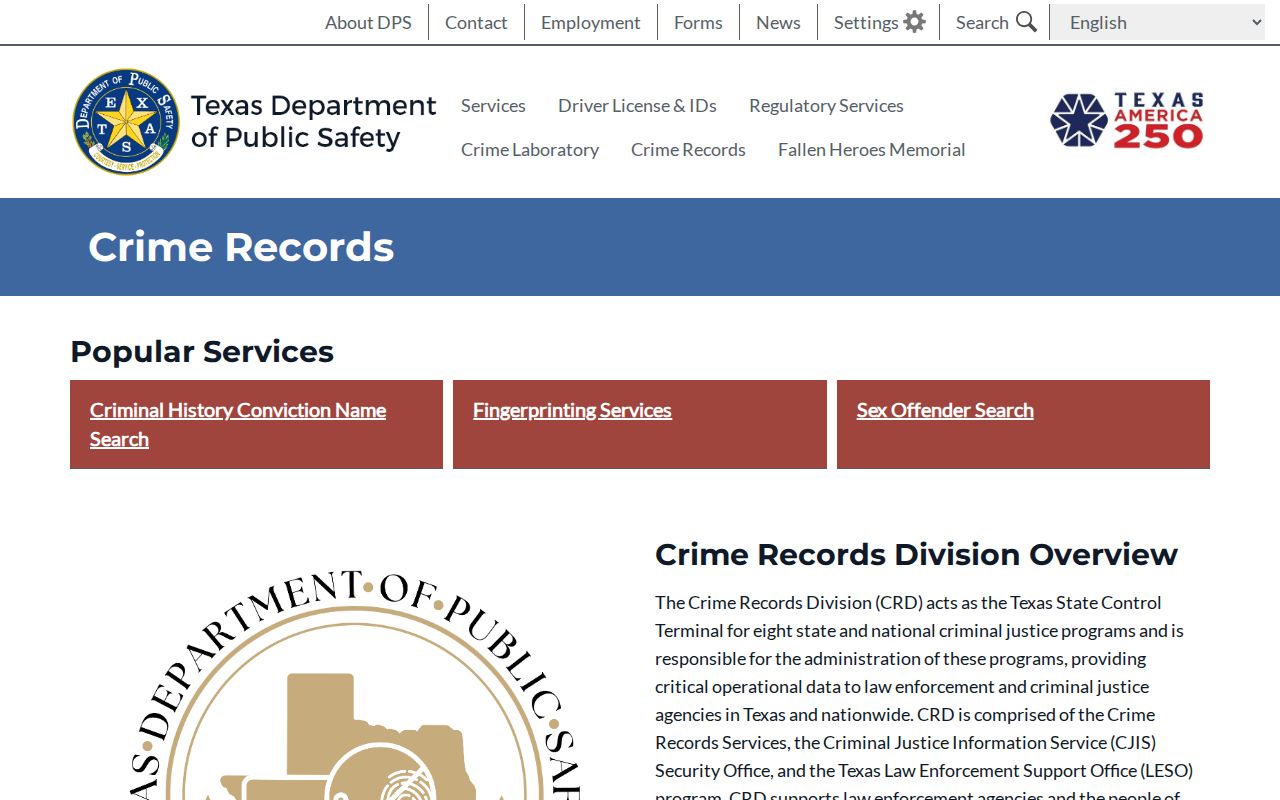
That statewide role explains why the Harris County registering office verifies local facts while DPS maintains the central public display.
The public inventory is broad, but its omissions are deliberate. Home, work, and mobile telephone numbers remain outside the public profile. So do the registrant's driver-license and Social Security numbers, employer identity and contact details, and all facts identifying the victim. Harris County registry readers should not try to reconstruct those protected fields from other material. The public display already provides the identity and status details that Texas selected for community awareness.
Harris County Registry Risk Terms
Texas risk numbers are community-risk assessments. They are not federal SORNA Tier I, II, and III duration labels. Level 1 means the assessment indicates low danger and the person is not likely to engage in criminal sexual conduct. Level 2 describes moderate danger and possible continued conduct. Level 3 describes serious danger and expected continued conduct. Civil Commitment is a separate display for a sexually violent predator under civil commitment.
Read the exact words shown. A risk level does not decide whether a Harris County registration lasts ten years or life. Duration depends on the reportable offense and the calculation required by Article 62.101. The profile's compliance status also has a focused meaning. It can flag whether required registration steps appear current, but it does not prove a new crime or predict what a person will do. If a status seems wrong, report it to the registering authority or DPS instead of drawing a public conclusion.
Aliases, tattoos, vehicles, and physical traits can help corroborate a common-name result. None should be treated as a substitute for the whole profile.
The public photograph can also be updated through state identification or driver-license renewal, and authorities collect fingerprints even though those prints are not a public search field. A Harris County match should rely on the photo together with the name, aliases, age, physical description, and SID. One trait can change or be entered incorrectly. Several consistent traits provide a sounder basis for identifying the intended profile without making claims beyond what the registry states.
Registration Requirements and Levels in Texas
Texas separates risk assessment, registration duration, and verification frequency. This distinction prevents a common error in Harris County registry searches. A numeric risk level shapes how danger and notification are described. The offense category controls whether the duty generally runs for ten years after supervision ends or for life. Verification is at least annual, while certain categories report every 90 days. The precise offense, disposition date, and supervision or release history must be checked against Code of Criminal Procedure Chapter 62.
| Texas Display or Rule | Duration and Visibility | Verification |
|---|---|---|
| Risk Level 1, low | Public while the offense-based registration duty remains; level does not set duration. | At least annual, unless a more frequent rule applies. |
| Risk Level 2, moderate | Public while the offense-based registration duty remains; level does not set duration. | At least annual, unless a more frequent rule applies. |
| Risk Level 3, high | Public registry plus enhanced notification; level does not set duration. | At least annual, with certain categories every 90 days. |
| Civil Commitment | Enhanced display tied to continuing statutory duties. | As required by the applicable commitment and registration rules. |
| Limited-duration offense | Generally until the tenth anniversary after release from supervision or discharge as Article 62.101 calculates it. | At least annual, unless a more frequent rule applies. |
| Lifetime offense | Life, unless a specific statute or court action changes the duty. | At least annual, unless a more frequent rule applies. |
DPS removes a person when it verifies that the duty expired under Article 62.251. A person, representative, court, or local authority may start the proper notice or request route. Do not infer an end date from the risk number.
The ten-year measure does not simply begin on the conviction date. Article 62.101 calculates the limited duty from release from supervision or discharge, depending on the case. Lifetime categories are tied to offenses the statute names. Juvenile treatment can also differ when a court orders nonpublic handling. For that reason, the Harris County registry's displayed status and the current statute are stronger than a duration guessed from the offense label alone.
Harris County Community Notification
Community notification is not the same as a person running a registry search. The DPS portal is available for a user-led name or location query. Chapter 62 also directs official notices in defined cases. DPS sends English and Spanish postcard notice to the immediate community when a high-risk registrant or a civilly committed sexually violent predator is released or moves there. Local authorities notify school officials as the law directs, while omitting victim identity and protected numbers.
That system uses the risk assessment for notification. It still does not turn the risk number into a registration-duration tier. Local registries must release public registration information on request and may recover a reasonable administrative cost. If a needed public field is not easy to find online, a focused Texas Public Information Act request can ask the registering authority for releasable information. Article 62.005 still blocks protected fields.
A Harris County request should identify the type of public registration information sought without asking for the victim's identity, private phone numbers, employer details, or other excluded data.
School notice follows a separate official path. The responsible authority provides the information Chapter 62 directs, with protected victim and identifying data removed. A postcard, school notice, and self-initiated Harris County sex offender check therefore may address the same registration but serve different audiences and rules. Receiving no postcard is not the same as receiving a clean radius search. Each mechanism has its own legal trigger and geographic scope.
Cross-State Harris County Searches
A move, former address, or out-of-state offense can call for more than a Texas search. NSOPW provides the federal public gateway across participating jurisdictions. Search the relevant names and locations there, then open the source jurisdiction's record for its current public facts. A national result is a routing layer. It does not replace the Texas profile or the local Harris County authority that receives required updates.
Offline help remains available. DPS Sex Offender Registration staff can be reached at 512-424-2800 through Crime Records Service. A local status concern goes to Houston Police or HCSO according to where the person registers. When an address or compliance field appears stale, give the agency the public record identifier and the specific concern. Let officials check it.
The official Texas criminal-history statute page supplies broader context for state-held crime records.
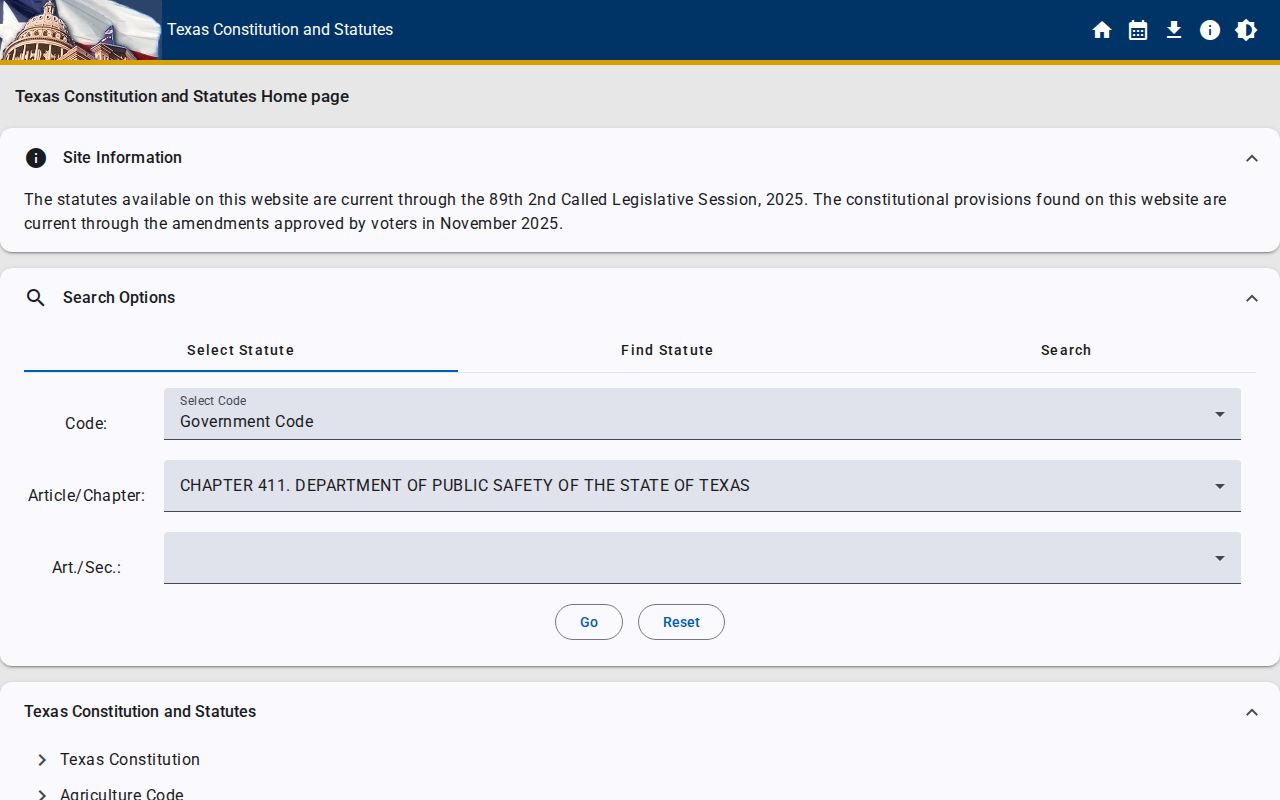
Registry access is more specifically governed by Chapter 62, so readers should use the law tied to the exact record and question.
A written request is another fallback for releasable local registration data that is not convenient to view online. Address it to the actual municipal police department or HCSO based on the registration location. The agency may charge a reasonable administrative cost and must still redact Article 62.005 exclusions. This route is useful for a defined public record, but it is not a way to demand private fields or force one Harris County office to search another agency's files.
Lawful Use and Community Notification
The registry supports public protection and informed safety planning. It does not grant permission to threaten, harass, trespass, damage property, expose a victim, or commit violence. Readers should verify a match with several public profile fields and report suspected errors through official channels. A profile may lag a move or depend on the person's compliance, so ordinary judgment and direct reporting still matter.
Registry misuse can bring legal penalties. Threats, harassment, stalking, trespass, property damage, or violence based on registry data can be crimes under Texas law. Article 62.0061 also sets a $1,000 civil penalty for each misuse or rule violation by a commercial social-networking site that receives the specialized registry extract.
Article 62.005 defines the public disclosure boundary. It withholds victim identity and several sensitive identifiers. A safe Harris County practice is simple: use public details to understand the record, keep protected people out of the discussion, and send a suspected violation to law enforcement.
Accuracy concerns should follow the same official path. Note the SID, the specific public field, and why it appears inconsistent, then contact the local registering authority or DPS. Officials can compare the Harris County registry display with the underlying registration submission. Public confrontation cannot correct a state record and may create risk. A measured report gives the custodian concrete facts to review while preserving the safety purpose of the Texas Public Sex Offender Registry.